 Add to Chrome
 Add to Firefox
 Add to Edge
Improving CLIP Adaptation by Breaking Tail Alignment for Source-Free Cross-Domain Few-Shot Learning
May 28, 2026
Vision-Language Models (VLMs) such as CLIP demonstrate strong zero-shot generalization, but their performance significantly degrades in cross-domain scenarios with scarce target-domain training data (Cross-Domain Few-Shot Learning, CDFSL). In this paper, we focus on the target-domain few-shot finetuning in the CLIP-based CDFSL task. Prevailing finetuning paradigms uniformly align all image patch tokens with their corresponding textual embeddings. However, we find a counterintuitive phenomenon: actively pushing away certain low-similarity image tokens, termed "tail tokens", from their textual embeddings consistently improves target-domain performance. We delve into this phenomenon and provide a novel interpretation: under great domain shifts and scarce training data, the model can hardly extract semantic information from visual inputs; therefore, the common belief of alignment is valid only for tokens already containing sufficient semantic information; for tail tokens, forcing the alignment would lead to excessive overfitting to the scarce training, while breaking the alignment is more useful. Motivated by this, we propose Adaptive Tail-Head Alignment (ATHA), a novel fine-tuning strategy for CLIP that transforms the conventional uniform alignment paradigm to an adaptive alignment paradigm, with both alignment strengthening and weakening. Extensive experiments on four challenging CDFSL benchmarks validate our state-of-the-art performance. Our code is available at https://github.com/shuaiyi308/ATHA.

Addressing Exacerbated Attention Sink for Source-Free Cross-Domain Few-Shot Learning
May 25, 2026Vision-language models (VLMs) like CLIP have shown impressive generalization capabilities, yet their potential for Cross-Domain Few-Shot Learning (CDFSL) remains underexplored, where the model needs to transfer source-domain information to target domains with scarce training data. While the attention sink phenomenon has been observed in VLMs for certain tasks, its role in CDFSL scenarios has not been studied. In this paper, we uncover a critical issue overlooked by prior works: standard target-domain few-shot fine-tuning in CDFSL significantly exacerbates the attention sink problem, leading to poor discriminability across classes. To understand this phenomenon, through extensive experiments, we interpret it as the model's shortcut learning for domain adaptation: to overcome the huge domain gap between the source and target domains, the model shows a high tendency to push tokens that are initially closer to target-domain classes (i.e., simple tokens) to be even closer to these classes, exacerbating the attention sink and wasting the capability of learning other discriminative but initially further tokens (i.e., hard tokens). To address this, we propose a novel approach to dynamically re-weight tokens according to their relevance with target-domain classes during the target-domain finetuning, which explicitly suppresses the model's reliance on these simple tokens and enhances the learning of hard tokens, reducing sink tokens and enhancing discriminability. Extensive experiments on four benchmark datasets validate the rationale of our method, demonstrating new state-of-the-art performance. Our codes are available at https://github.com/shuaiyi308/TIR.
Reviving In-domain Fine-tuning Methods for Source-Free Cross-domain Few-shot Learning
May 12, 2026Cross-Domain Few-Shot Learning (CDFSL) aims to adapt large-scale pretrained models to specialized target domains with limited samples, yet the few-shot fine-tuning of vision-language models like CLIP remains underexplored. By establishing multiple fine-tuning baselines of CLIP for CDFSL, we find adapter-based methods (e.g., LoRA) consistently outperform prompt-based ones (e.g., MaPLe), contrary to in-domain scenarios. To make those effective in-domain methods competitive again in CDFSL, we analyze this phenomenon and discover LoRA's superiority stems from rectifying the collapsed attention of visual CLS token, enhancing modality alignment and class separation by focusing on text-related visual regions. Further, we find textual EOS token exhibit much better attention to visual samples, and CLIP's standard contrastive loss weakly constrains modality alignment. Based on these insights, we propose Semantic Probe, a plug-and-play attention rectification framework for both adapter- and prompt-based methods. Extensive experiments on four CDFSL benchmarks validate our rationale, achieving state-of-the-art performance and benefiting both fine-tuning paradigms. Codes will be released.
BetaEdit: Null-Space Constrained Sequential Model Editing
May 10, 2026Null-space-based methods have garnered considerable attention in model editing by constraining updates to the null space of the pre-existing knowledge representation, thereby preserving the model's original behavior. However, in practice these methods rely on an approximate null space--leading to knowledge leakage--and further suffer from severe performance degradation during sequential editing. Recent work shows that history-aware editing strategies can empirically mitigate this decline, yet the underlying reason remains unclear. In this paper, we first expose the knowledge leakage inherent in existing null-space approaches and then analyze why history-aware updates effectively preserve both editing performance and general capabilities during long-horizon editing. Building on these insights, we propose BetaEdit, a refined framework that effectively controls the knowledge leakage and integrates history-aware updates into the null-space paradigm. Extensive experiments on three large language models across two standard benchmarks show that BetaEdit consistently outperforms prior methods in the challenging regime of massive-scale sequential editing. Code is available at: https://github.com/lbq8942/BetaEdit.
Remedying Target-Domain Astigmatism for Cross-Domain Few-Shot Object Detection
Mar 19, 2026Cross-domain few-shot object detection (CD-FSOD) aims to adapt pretrained detectors from a source domain to target domains with limited annotations, suffering from severe domain shifts and data scarcity problems. In this work, we find a previously overlooked phenomenon: models exhibit dispersed and unfocused attention in target domains, leading to imprecise localization and redundant predictions, just like a human cannot focus on visual objects. Therefore, we call it the target-domain Astigmatism problem. Analysis on attention distances across transformer layers reveals that regular fine-tuning inherently shows a trend to remedy this problem, but results are still far from satisfactory, which we aim to enhance in this paper. Biologically inspired by the human fovea-style visual system, we enhance the fine-tuning's inherent trend through a center-periphery attention refinement framework, which contains (1) a Positive Pattern Refinement module to reshape attention toward semantic objects using class-specific prototypes, simulating the visual center region; (2) a Negative Context Modulation module to enhance boundary discrimination by modeling background context, simulating the visual periphery region; and (3) a Textual Semantic Alignment module to strengthen center-periphery distinction through cross-modal cues. Our bio-inspired approach transforms astigmatic attention into focused patterns, substantially improving adaptation to target domains. Experiments on six challenging CD-FSOD benchmarks consistently demonstrate improved detection accuracy and establish new state-of-the-art results.
Interpretable Cross-Domain Few-Shot Learning with Rectified Target-Domain Local Alignment
Mar 18, 2026Cross-Domain Few-Shot Learning (CDFSL) adapts models trained with large-scale general data (source domain) to downstream target domains with only scarce training data, where the research on vision-language models (e.g., CLIP) is still in the early stages. Typical downstream domains, such as medical diagnosis, require fine-grained visual cues for interpretable recognition, but we find that current fine-tuned CLIP models can hardly focus on these cues, albeit they can roughly focus on important regions in source domains. Although current works have demonstrated CLIP's shortcomings in capturing local subtle patterns, in this paper, we find that the domain gap and scarce training data further exacerbate such shortcomings, much more than that of holistic patterns, which we call the local misalignment problem in CLIP-based CDFSL. To address this problem, due to the lack of supervision in aligning local visual features and text semantics, we turn to self-supervision information. Inspired by the translation task, we propose the CC-CDFSL method with cycle consistency, which translates local visual features into text features and then translates them back into visual features (and vice versa), and constrains the original features close to the translated back features. To reduce the noise imported by richer information in the visual modality, we further propose a Semantic Anchor mechanism, which first augments visual features to provide a larger corpus for the text-to-image mapping, and then shrinks the image features to filter out irrelevant image-to-text mapping. Extensive experiments on various benchmarks, backbones, and fine-tuning methods show we can (1) effectively improve the local vision-language alignment, (2) enhance the interpretability of learned patterns and model decisions by visualizing patches, and (3) achieve state-of-the-art performance.
Reclaiming Lost Text Layers for Source-Free Cross-Domain Few-Shot Learning
Mar 05, 2026Source-Free Cross-Domain Few-Shot Learning (SF-CDFSL) focuses on fine-tuning with limited training data from target domains (e.g., medical or satellite images), where CLIP has recently shown promising results due to its generalizability to downstream tasks. Current works indicate CLIP's text encoder is more suitable for cross-domain tasks, however, we find that \textbf{removing certain middle layers of the text encoder can effectively improve performance in SF-CDFSL}, which we call the Lost Layers. In this paper, we delve into this phenomenon for a deeper understanding. We discover that instead of being harmful for the SF-CDFSL task, the information in these layers is actually beneficial, but visual gaps prevent this useful information from being fully utilized, making these layers seem redundant. Based on this understanding, unlike current works that simply remove these layers, we propose a method to teachs the model to \textbf{re-utilize} information in these lost layers at both the layer and encoder levels, guiding the re-learning of the visual branch under domain shifts. Our approach effectively addresses the issue of underutilized information in the text encoder. Extensive experiments across various settings, backbones (CLIP, SigLip, PE-Core), and tasks (4 CDFSL datasets and 10 Meta-dataset datasets) demonstrate the effectiveness of our method. Code is available at https://github.com/zhenyuZ-HUST/CVPR26-VtT.
Chain of Mindset: Reasoning with Adaptive Cognitive Modes
Feb 10, 2026Human problem-solving is never the repetition of a single mindset, by which we mean a distinct mode of cognitive processing. When tackling a specific task, we do not rely on a single mindset; instead, we integrate multiple mindsets within the single solution process. However, existing LLM reasoning methods fall into a common trap: they apply the same fixed mindset across all steps, overlooking that different stages of solving the same problem require fundamentally different mindsets. This single-minded assumption prevents models from reaching the next level of intelligence. To address this limitation, we propose Chain of Mindset (CoM), a training-free agentic framework that enables step-level adaptive mindset orchestration. CoM decomposes reasoning into four functionally heterogeneous mindsets: Spatial, Convergent, Divergent, and Algorithmic. A Meta-Agent dynamically selects the optimal mindset based on the evolving reasoning state, while a bidirectional Context Gate filters cross-module information flow to maintain effectiveness and efficiency. Experiments across six challenging benchmarks spanning mathematics, code generation, scientific QA, and spatial reasoning demonstrate that CoM achieves state-of-the-art performance, outperforming the strongest baseline by 4.96\% and 4.72\% in overall accuracy on Qwen3-VL-32B-Instruct and Gemini-2.0-Flash, while balancing reasoning efficiency. Our code is publicly available at \href{https://github.com/QuantaAlpha/chain-of-mindset}{https://github.com/QuantaAlpha/chain-of-mindset}.
Decoupling Template Bias in CLIP: Harnessing Empty Prompts for Enhanced Few-Shot Learning
Dec 10, 2025The Contrastive Language-Image Pre-Training (CLIP) model excels in few-shot learning by aligning visual and textual representations. Our study shows that template-sample similarity (TSS), defined as the resemblance between a text template and an image sample, introduces bias. This bias leads the model to rely on template proximity rather than true sample-to-category alignment, reducing both accuracy and robustness in classification. We present a framework that uses empty prompts, textual inputs that convey the idea of "emptiness" without category information. These prompts capture unbiased template features and offset TSS bias. The framework employs two stages. During pre-training, empty prompts reveal and reduce template-induced bias within the CLIP encoder. During few-shot fine-tuning, a bias calibration loss enforces correct alignment between images and their categories, ensuring the model focuses on relevant visual cues. Experiments across multiple benchmarks demonstrate that our template correction method significantly reduces performance fluctuations caused by TSS, yielding higher classification accuracy and stronger robustness. The repository of this project is available at https://github.com/zhenyuZ-HUST/Decoupling-Template-Bias-in-CLIP.
Beyond Higher Rank: Token-wise Input-Output Projections for Efficient Low-Rank Adaptation
Oct 27, 2025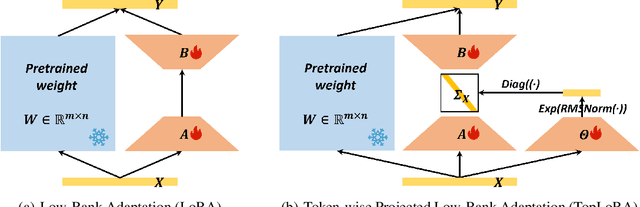
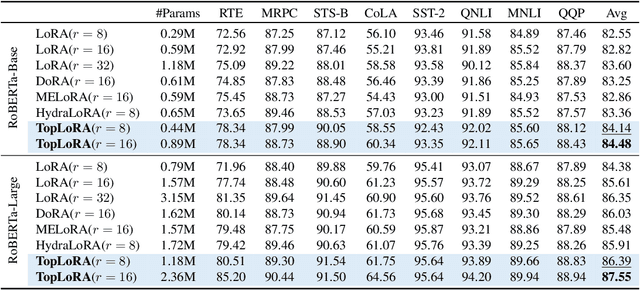
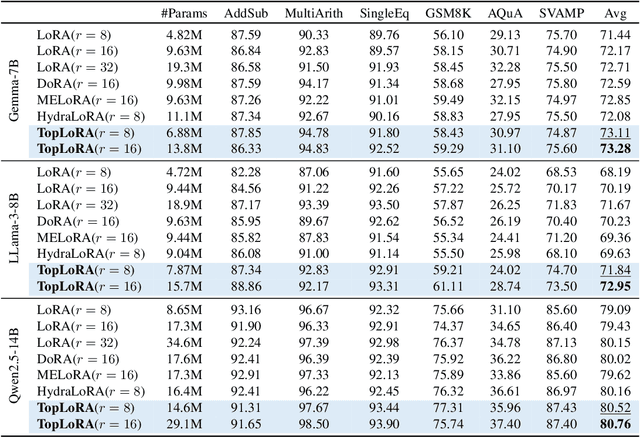
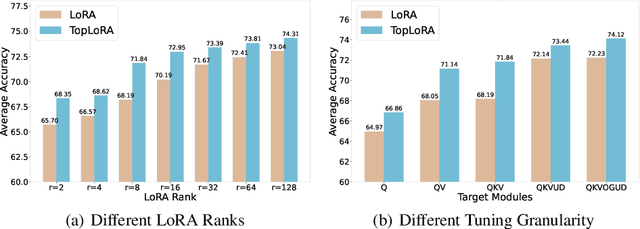
Low-rank adaptation (LoRA) is a parameter-efficient fine-tuning (PEFT) method widely used in large language models (LLMs). LoRA essentially describes the projection of an input space into a low-dimensional output space, with the dimensionality determined by the LoRA rank. In standard LoRA, all input tokens share the same weights and undergo an identical input-output projection. This limits LoRA's ability to capture token-specific information due to the inherent semantic differences among tokens. To address this limitation, we propose Token-wise Projected Low-Rank Adaptation (TopLoRA), which dynamically adjusts LoRA weights according to the input token, thereby learning token-wise input-output projections in an end-to-end manner. Formally, the weights of TopLoRA can be expressed as $B\Sigma_X A$, where $A$ and $B$ are low-rank matrices (as in standard LoRA), and $\Sigma_X$ is a diagonal matrix generated from each input token $X$. Notably, TopLoRA does not increase the rank of LoRA weights but achieves more granular adaptation by learning token-wise LoRA weights (i.e., token-wise input-output projections). Extensive experiments across multiple models and datasets demonstrate that TopLoRA consistently outperforms LoRA and its variants. The code is available at https://github.com/Leopold1423/toplora-neurips25.